AquaFit Official Website › Blog › Capsules, Gummies Or Drops: Which Format To Buy
Capsules, Gummies Or Drops: Which Format To Buy
Three answers to the same question, each trading something away. The interesting difference is not convenience, it is how much each format tells you about itself before you swallow it.
- A capsule carries no sugar and no acid, is swallowed in two seconds, and is stable on a shelf.
- It also shows you nothing, which puts all the weight on the label.
- A gummy shows you its size and its sugar. A liquid shows you colour, clarity and smell.
- The format does not change the evidence base, the need for an amount on the label, or the regulatory position.
- Buy the format you will still be taking in week five, then judge the product on its label.
The three formats, and what each one gives up
Capsules, gummies and liquid drops are three answers to the same question: how do you get a powder or an extract into somebody every day. Each one trades something away.
| Format | What it is good at | What it gives up |
|---|---|---|
| Vegetable capsule | No sugar, no acid, no flavour, swallowed in two seconds, stable on a shelf | Shows you nothing about its contents, and has to be swallowed |
| Gummy | Pleasant, easy for people who dislike swallowing, visible portion | Carries sugar or sweetener, needs gelling agents, and holds less active material per unit |
| Liquid drops | Flexible dosing, absorbed without a shell, easy to adjust | Taste, shorter shelf life once opened, and measurement error every time |
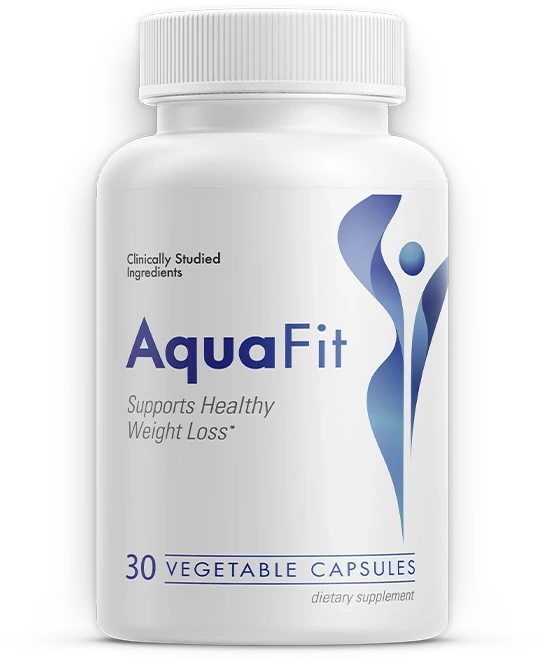
AquaFit is a vegetable capsule, thirty to a bottle, printed across the base of the front label. It is not a gummy, not a chewable and not a drop, and any listing that describes it as one of those is describing a different product.
The capsule trade-off nobody mentions
Capsules are usually sold on convenience, and the real trade is about information rather than convenience.
A gummy tells you something about itself. You can see its size, taste its sweetener and read its sugar content, and a gummy that has been sitting in a hot car announces the fact. A liquid tells you even more: colour, clarity, smell, and whether it has separated. A capsule tells you nothing at all. An opaque shell, a uniform size, and a powder nobody outside the factory has seen.
That makes the label the only thing a capsule buyer can inspect before paying, which is fine when the label is complete and a real problem when it is not. It is the reason this desk publishes a twelve-point label checklist and scores its own product against it in public.
Two capsule questions worth asking
- Gelatin or vegetable? A gelatin shell is an animal product. A vegetable shell, usually hypromellose, is not. This one is vegetable, which the front label states and the pack seal corroborates.
- How many capsules is a serving? Thirty capsules is a month at one a day and ten days at three. Without a serving size the bottle count means nothing, and on this product the sales page does not print one.
Which format suits which buyer
There is no best format. There is a format that matches how you actually behave, which is a different and more useful question.
- Choose a capsule if you will forget a bottle that has to be measured, if you dislike sweetened products, or if you want the option of taking it away from home without it melting or leaking.
- Choose a gummy if swallowing is genuinely difficult, or if a pleasant ritual is what will keep you taking it. Adherence beats theoretical superiority every time.
- Choose drops if you need to adjust an amount, or if you are giving something to somebody who cannot swallow a capsule.
The honest ranking for most adults is whichever one you will still be taking in week five. That is not a platitude: across the weight literature, adherence rather than mechanism is what separates a result from a non-result.
How long each format lasts, opened and unopened
The difference here is larger than most buyers expect, and it decides whether a multi-bottle pack is sensible or wasteful.
| Format | Unopened | Once opened | What degrades it |
|---|---|---|---|
| Vegetable capsule | Typically two years from manufacture | Stable for the life of the bottle if kept dry | Heat and humidity, which soften the shell |
| Gummy | Usually shorter | Weeks to months, and texture changes first | Heat, which melts and fuses them, and air, which dries them |
| Liquid drops | Often one to two years | Frequently one to three months once opened | Oxygen, light, and contamination from the dropper |
That table is the reason a six-bottle capsule pack is a reasonable thing to exist where a six-jar gummy pack often is not. A sealed capsule bottle in a cupboard is genuinely stable, and only one bottle is open at a time.
Two storage rules that follow. Keep the pack in a cupboard rather than on a windowsill or near a kettle, because heat and steam are what age a capsule shell. And check the best-before date on arrival: on a six-bottle pack there should be comfortable room beyond six months, and if there is not, that is a call to the order desk on +1 (888) 254-0425 rather than something to accept.
What the format does not change
A format argument can be a distraction, so it is worth naming the four things that are identical across all three.
- The evidence base. A compound in a capsule has the same literature as the same compound in a gummy. Pooled effects in this category are small either way (Bessell 2021).
- The need for an amount on the label. A name with no number is uninformative in every format.
- The regulatory position. All three are dietary supplements, none is FDA-approved, and the same claim rules apply (the FDA).
- The importance of the seller. A telephone number, a street address and a refund window matter identically whichever shape the product arrives in.
Order AquaFit in the format it actually is
A vegetable capsule, thirty to a bottle, with a traceable lot and 60 days from purchase to change your mind.
Current pack totals are shown at checkout
Order AquaFit On The Official WebsiteHow format affects what pack to buy
One practical consequence. A capsule is shelf-stable in a way a gummy is not, which changes how a multi-bottle pack should be judged.
| Pack | Days of supply | Storage comment |
|---|---|---|
| 1 bottle | 30 | No storage question at all |
| 2 bottles | 60 | One sealed bottle waiting, which is the ideal arrangement |
| 3 bottles | 90 | Two sealed. Covers the full 60-day guarantee window |
| 6 bottles | 180 | Five sealed for up to half a year. Check the best-before date on arrival |
A sealed capsule bottle in a cupboard is a genuinely stable thing, which is what makes larger packs reasonable in this format where they would be marginal in a gummy. The limit is not storage, it is the refund window: four of the six months in the largest pack sit outside it. The pricing page works through that properly.
The verdict on formats
Buy the format you will keep taking, and then judge the product on its label rather than on its shape. A capsule with a full panel beats a gummy with none, and a gummy with a full panel beats a capsule with none.
On this product the format is a vegetable capsule and the label is the weak part, which is set out at length on the ingredients page. What the desk offers instead is traceability, a telephone line and a 60-day window, and a buyer is entitled to weigh those against the missing panel however they like.
A note on this category. AquaFit is a dietary supplement, not a treatment for any condition. It is for healthy adults 18 and over, and it is not for anyone under 18, pregnant or nursing. Speak to a clinician before use if you take prescription medication.
Why format changes what a label has to do
The through-line of this whole article, stated once at the end. The less a product reveals about itself, the more work its label has to do, and the more a buyer should expect from it.
- A liquid shows colour, clarity and smell, so a buyer has a crude independent check on it before the label is even read.
- A gummy shows size, texture and sweetness, and its sugar content is a required declaration that is genuinely informative.
- A capsule shows an opaque shell. Everything a buyer knows about the contents comes from the label, and nothing else.
Which is why a capsule with a complete panel is one of the better propositions in this aisle and a capsule with no panel is one of the harder ones to assess. That is this product’s position, set out properly on the ingredients page, and it is the reason this desk publishes a checklist its own product fails on four points.
Sources
- Bessell E, Maunder A, Lauche R, et al. Efficacy of dietary supplements containing isolated organic compounds for weight loss: a systematic review and meta-analysis of randomised placebo-controlled trials. Int J Obes (Lond). 2021;45(8):1631-1643. https://pubmed.ncbi.nlm.nih.gov/33976376/
- U.S. Food and Drug Administration. Questions and Answers on Dietary Supplements. https://www.fda.gov/food/information-consumers-using-dietary-supplements/questions-and-answers-dietary-supplements
- National Institutes of Health, Office of Dietary Supplements. Dietary Supplements: What You Need to Know. https://ods.od.nih.gov/factsheets/WYNTK-Consumer/
- U.S. National Library of Medicine, MedlinePlus. Dietary Supplements. https://medlineplus.gov/dietarysupplements.html

We write these pages from the AquaFit label, the distributor’s own paperwork and the order desk, cite public research for every compound we name, and print “not published” wherever a figure is not disclosed rather than estimating it. This label names no ingredients and publishes no panel, and we say so on every page where a buyer would look for one. Corrections are made on the page and the review date moves forward. Write to [email protected]. Every page, every journal post, the bottle facts and the ingredients go through review by Dr. Chioma Okafor-Mbah, MD before they ship. Last reviewed September 2026 by Dr. Chioma Okafor-Mbah, MD.