AquaFit Official Website › Choosing A Capsule Supplement
Choosing A Capsule Supplement: Twelve Checks Before You Buy
Twelve things to look for on any capsule supplement label, why each one matters, and a score at the end for the product this desk happens to sell. Four of the twelve are checks it fails.
Twelve checks: the ingredient list, the amounts, the serving size, the allergen statement, the capsule type, the lot code, the seals, the seller's contact details, the refund window, the price per day, the claims and the evidence.
A capsule hides its contents completely, which makes the label the only thing a buyer can inspect before paying. This checklist is what to inspect it for.
What a capsule can and cannot show you
A gummy shows you its colour and tells you its sugar. A powder shows you its volume. A capsule shows you nothing: an opaque shell, a uniform size, and a powder nobody outside the factory has seen. Every judgement about a capsule is therefore a judgement about a label.
That is not an argument against capsules, which carry no sugar and no acid and do not degrade the way a chewable can. It is an argument for reading the label more carefully.
Twelve checks, in the order they matter
| # | Check | Why it matters |
|---|---|---|
| 1 | Every ingredient named | Without it, nothing else on this list can be evaluated and no clinician can screen it |
| 2 | An amount beside each name | A name tells you which research the seller wants credit for. An amount tells you whether it qualifies |
| 3 | A serving size | Thirty capsules is a month at one a day and ten days at three. The count means nothing without it |
| 4 | An allergen statement | Seals for single allergens are useful and are not a declaration |
| 5 | The capsule type | Gelatin or vegetable. It decides whether the product suits a vegetarian at all |
| 6 | A lot code on the bottle | The only way a specific bottle can ever be traced back to a production run |
| 7 | A best-before date | Printed with the lot, usually on the base |
| 8 | Manufacturing seals you can interpret | GMP describes a facility. FDA-registered describes a listing. Neither describes the capsule |
| 9 | A seller with a street address | Cheap to publish, and most sellers in this category still do not |
| 10 | A telephone number that is answered | Test it before ordering. It takes two minutes |
| 11 | A refund window long enough to matter | Thirty days is shorter than most of these products take to show anything |
| 12 | Claims that match the label | An advertisement bolder than the bottle has stepped outside it |
How to read a Supplement Facts panel in sixty seconds
A Supplement Facts panel is a regulated format, which makes it easy to read once you know what the columns are for. The FDA publishes the labelling guide that defines it (the FDA labeling guide).
- ●Serving size, at the top. Every number below it refers to that serving, not to one capsule, unless they are the same thing
- ●Servings per container. Divide the bottle count by the serving size and you have the real supply
- ●Amount per serving. The column that matters. Compare it with the amounts used in trials, not with the amounts on the front of the box
- ●Percent daily value. Present for nutrients that have one. A dagger usually means no daily value has been established
- ●Other ingredients, below the box. The capsule shell, fillers and flow agents. This is where you find out whether the shell is vegetable
Sixty seconds on that box tells you more than an hour on the rest of the packaging, which is presumably why the rest of the packaging is designed to be more interesting.
Proprietary blends, and what a blend total hides
A proprietary blend lists several ingredients and gives one number for all of them together. It is lawful, it is common, and it removes the single most useful figure on the panel.
Two rules make a blend readable. The first is that ingredients are listed by weight, so the first name in the blend is present in the largest amount. The second is that the blend total is a ceiling: no ingredient in it can exceed the total, which means a 100 mg blend of eight ingredients cannot contain a research dose of anything.
A label with no ingredient list at all is a further step again, and it is worth naming as such rather than filing it under the same heading. With a blend you can at least apply the ceiling rule. With no list there is nothing to apply it to.
Which badges mean something and which are decoration
| Seal | What it describes | How much it tells you |
|---|---|---|
| GMP certified | How a facility documents and controls its processes | Real, and about a building rather than a capsule |
| FDA-registered facility | That a facility is listed with the FDA | Not approval, not inspection of the product |
| Made in the USA | Where it was blended and bottled | Says nothing about where the raw materials came from |
| Third-party tested | That an outside laboratory ran an assay | Only meaningful with a certificate you can read |
| Non-GMO | A sourcing claim about the raw materials | Needs an ingredient list to attach to |
| Natural | Nothing fixed | No settled regulatory definition for supplements |
| Doctor formulated | A manufacturer's statement about its own process | Nothing checkable unless a clinician is named |
| Money-back guarantee | A commercial policy | The only badge you can test with a telephone call |
Run four questions across any seal: who issued it, what does it describe, can it be checked, and does the label support it. A vegetarian seal on a bottle that prints vegetable capsules passes all four. A natural ingredients seal on a bottle that names no ingredients fails the last one outright.
Price per day, and a refund window that covers the question
Two checks that have nothing to do with chemistry and are the ones most often skipped.
Price per day. Divide the total by the number of days of supply, not by the number of bottles. A six-bottle pack at a low per-day cost is still six months of something untried, and the per-day figure is the only number that compares across brands and pack sizes.
The refund window against the timeline. Most products in this category are described by their own sellers as taking weeks. A thirty-day window closes before that question is answered, which makes it a policy that sounds generous and covers nothing. Sixty days is the shortest window that genuinely overlaps with the period a buyer needs.
The check that catches the most problems. Telephone the seller before ordering and ask one question about the product. Whether anybody answers, and what they say when they do not know, tells you more than any badge on the bottle.
AquaFit against these twelve checks
The desk publishing this checklist sells one of these products, so here it is scored against its own list, with the crosses printed rather than summarised.
| # | Check | AquaFit |
|---|---|---|
| 1 | Every ingredient named | No |
| 2 | An amount beside each name | No |
| 3 | A serving size | Not published on the sales page |
| 4 | An allergen statement | No. Gluten-free and dairy-free seals only |
| 5 | The capsule type | Yes. Vegetable capsule, printed on the front |
| 6 | A lot code on the bottle | Yes, AF-26/BR-5104 |
| 7 | A best-before date | Yes, printed with the lot on the base |
| 8 | Seals you can interpret | Yes, ten of them, each explained on the testing page |
| 9 | A seller with a street address | Yes, two: an office and a returns address |
| 10 | A telephone number | Yes, +1 (888) 254-0425 |
| 11 | A refund window long enough | Yes, 60 days from purchase |
| 12 | Claims that match the label | Yes on the bottle. The marketing artwork names four compounds the label does not |
Eight pass and four fail, and the four failures are checks one to four, which are the four at the top of the list because they are the ones that matter most. A reader who stops there has read the checklist correctly.
What the pass column buys is different in kind: traceability, contactability and a refund window. Those are the things a retail desk can actually control, and they are the reason to buy here rather than from a listing if you decide to buy at all.
Where the AquaFit pages get their evidence
These papers concern supplement categories and named compounds in general. None of them studied this capsule, and none could, because the label names no ingredient to study.
- U.S. Food and Drug Administration. Dietary Supplement Labeling Guide. https://www.fda.gov/food/dietary-supplements-guidance-documents-regulatory-information/dietary-supplement-labeling-guide
- U.S. Food and Drug Administration. Questions and Answers on Dietary Supplements. https://www.fda.gov/food/information-consumers-using-dietary-supplements/questions-and-answers-dietary-supplements
- Cohen PA, Avula B, Wang Y, et al. Presence and Quantity of Botanical Ingredients With Purported Performance-Enhancing Properties in Sports Supplements. JAMA Netw Open. 2023;6(7):e2323879. https://pubmed.ncbi.nlm.nih.gov/37459101/
- Starr RR. Too little, too late: ineffective regulation of dietary supplements in the United States. Am J Public Health. 2015;105(3):478-85. https://pubmed.ncbi.nlm.nih.gov/25602879/
- National Institutes of Health, Office of Dietary Supplements. Dietary Supplements: What You Need to Know. https://ods.od.nih.gov/factsheets/WYNTK-Consumer/
- Federal Trade Commission. Health Products Compliance Guidance. 2022. https://www.ftc.gov/business-guidance/resources/health-products-compliance-guidance
- U.S. National Library of Medicine, MedlinePlus. Dietary Supplements. https://medlineplus.gov/dietarysupplements.html

We write these pages from the AquaFit label, the distributor’s own paperwork and the order desk, cite public research for every compound we name, and print “not published” wherever a figure is not disclosed rather than estimating it. This label names no ingredients and publishes no panel, and we say so on every page where a buyer would look for one. Corrections are made on the page and the review date moves forward. Write to [email protected]. Every page, every journal post, the bottle facts and the ingredients go through review by Dr. Chioma Okafor-Mbah, MD before they ship. Last reviewed September 2026 by Dr. Chioma Okafor-Mbah, MD.
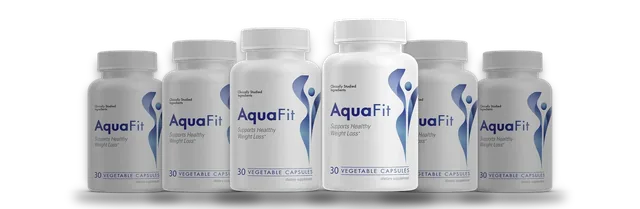
Order AquaFit with the checklist in hand
Eight of twelve checks passed, four failed, and the four failures printed above rather than left out. Sixty days from purchase either way.
Current pack totals are shown at checkout
Order AquaFit On The Official Website30 vegetable capsules a bottle · 60-day money-back guarantee · lot AF-26/BR-5104 · orders desk +1 (888) 254-0425