AquaFit Official Website › Blog › Chromium And Weight: What The Evidence Says
Chromium And Weight: What The Evidence Says
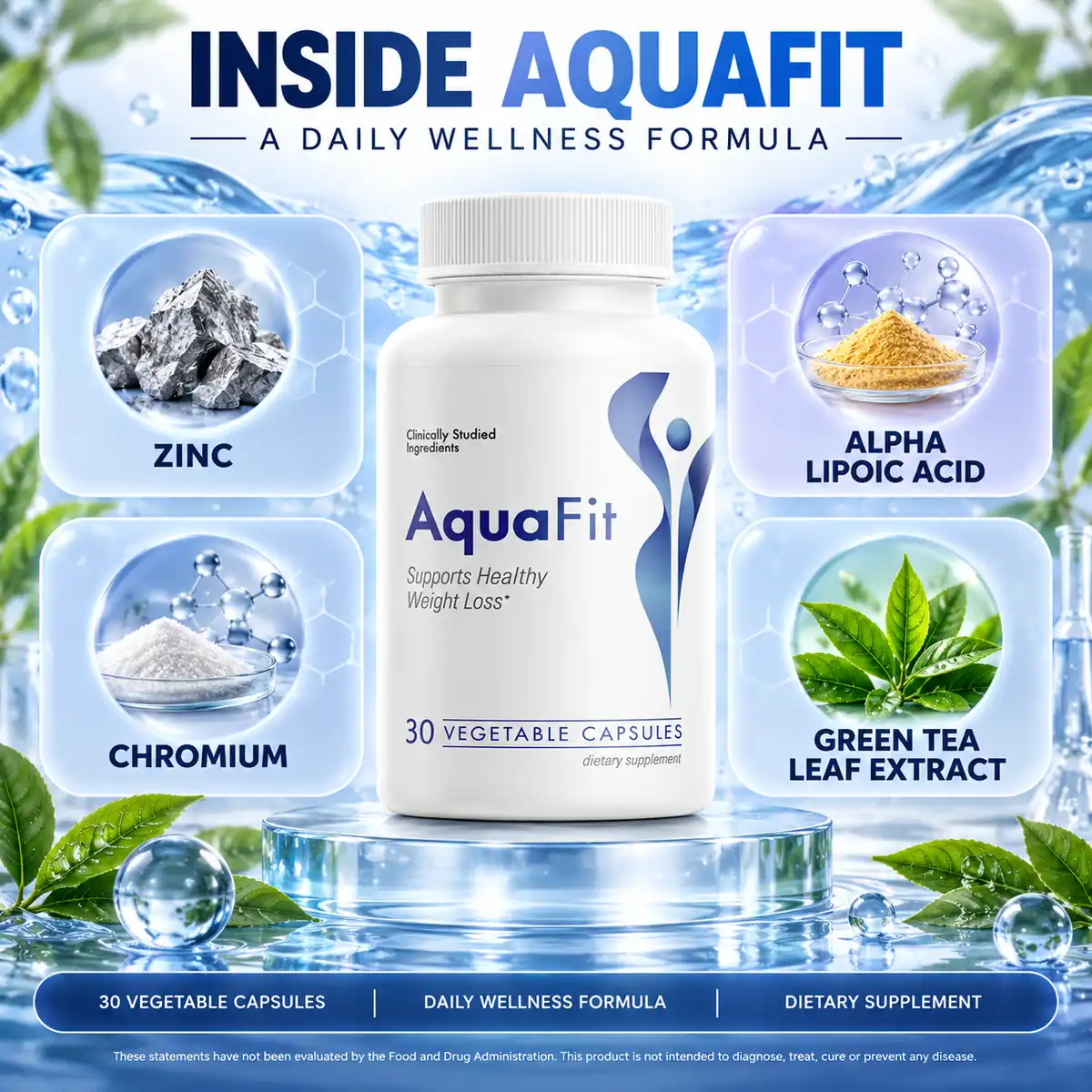
Chromium turns up on more labels in this category than any other mineral, including on the vendor artwork for this product. Here is what the pooled evidence actually found, and why the missing number beside the name matters more than the name does.
- The Cochrane review of chromium picolinate found a small pooled difference, graded the evidence low quality, and called the clinical relevance uncertain.
- Trials have generally used 200 to 1,000 micrograms a day for eight to twenty-four weeks.
- Chromium appears on this product's vendor artwork with no amount, and does not appear on the label at all.
- Chromium is common in multivitamins, which makes accidental duplication easy and a published panel valuable.
- The useful test on any label is not whether chromium is named. It is whether a number is printed beside it.
Why chromium turns up on so many labels
Chromium is an essential trace mineral with a genuine role in carbohydrate metabolism, and that sentence is the reason it appears on so many labels in this category. It is cheap, it is well tolerated, it has a plausible mechanism, and there is enough published research to support the word “studied” without anybody having to be creative.
It also appears on the vendor artwork for this product, described as helping to support healthy nutrient metabolism. That description is fair. What follows is what the research actually found when it was pooled.
What the Cochrane review found
The most important single paper on this question is the Cochrane review of chromium picolinate for overweight or obese adults (Tian 2013, Cochrane). Cochrane reviews matter here because their method is fixed in advance and their grading of evidence quality is explicit, which makes them harder to shade than a narrative review.
Three findings, in the order a buyer should care about them:
- The pooled difference against placebo was small. Detectable, and well under what most people would consider a reason to buy something.
- The evidence was graded low quality. Small trials, short durations, and variation in how outcomes were measured.
- The authors described the clinical relevance as uncertain. That is a careful phrase and it means what it says: they could not tell whether the difference they found would matter to anyone.
A later dose-response analysis in people with type 2 diabetes looked at body composition rather than weight alone and landed in a similarly modest place (Vajdi 2024).
What chromium actually does in the body
Worth a paragraph, because the mechanism is genuine and it is the reason the ingredient survives in this category despite modest trial results.
Chromium is an essential trace mineral. Its established role is in carbohydrate and lipid metabolism, where it is understood to act on insulin signalling. Severe deficiency is rare in people eating an ordinary mixed diet, and it is mostly described in clinical settings such as long-term intravenous nutrition without supplementation.
That is the whole of the uncontroversial part, and it contains the reason the trial results are modest. A nutrient that corrects a deficiency does most of its work in people who are deficient. In a healthy adult who is not, there is less for it to do, which is exactly the pattern the pooled data shows for several minerals in this category including zinc (Abdollahi 2020).
Where it occurs in food
- Wholegrains, and bran in particular
- Broccoli and green beans
- Meat, especially beef and poultry
- Nuts, and brazil nuts notably
- Grape juice and red wine
Amounts in food are small and vary with soil and processing, which is one reason intake is hard to estimate and a second reason trials in unselected adults are difficult to interpret. The NIH professional fact sheet for this category has the detail (the ODS professional fact sheet).
Chromium against the rest of the category
The useful comparison is not chromium against nothing. It is chromium against the other compounds a buyer meets on the same shelf, and against the things that are known to work.
| Compound or approach | Pooled finding | Source |
|---|---|---|
| Chromium picolinate | Small difference, low-quality evidence, uncertain relevance | Cochrane 2013 |
| Green tea preparations | Mean difference well under a kilogram, not clinically important | Cochrane 2012 |
| Alpha lipoic acid | Small average reduction at 300 to 1,800 mg daily | Namazi 2018 |
| Zinc | Effects in specific populations only, and small | Abdollahi 2020 |
| Herbal preparations as a class | No clinically meaningful difference | Maunder 2020 |
| A structured food and activity programme | Substantial and durable in the largest trial of its kind | Knowler 2002 |
The last row is the one that puts the others in proportion, and it is also the one with the highest cost in effort. Nobody buys a capsule because they think it outperforms a structured programme. They buy it because it takes two seconds, and that is a reasonable thing to want provided the expectation is set correctly.
How much chromium, and why the number is missing here
Trials of chromium picolinate have generally used amounts in the region of 200 to 1,000 micrograms a day, taken for eight to twenty-four weeks. Those are the numbers a buyer would compare a label against.
On this product there is nothing to compare. The bottle names no ingredient, the sales page publishes no Supplement Facts panel, and the artwork that names chromium gives no amount. So whatever the Cochrane review found, this capsule cannot claim it, because nothing establishes that chromium is present at all.
Two things a buyer can do with that
- Ask. The order desk will tell you honestly that it holds batch and shipping paperwork rather than a formulation sheet. That is a limit rather than an evasion, and it is worth hearing said out loud.
- Compare elsewhere. Any competitor with a published panel can be checked against the 200 to 1,000 microgram range in a few seconds. That comparison is the whole value of a panel.
Order AquaFit knowing what the artwork does and does not establish
Thirty vegetable capsules a bottle, a traceable lot, and 60 days from purchase to reach your own verdict.
Current pack totals are shown at checkout
Order AquaFit On The Official WebsiteIs chromium safe, and what to watch for
At the amounts used in trials, chromium picolinate is generally well tolerated in healthy adults. The NIH fact sheet for this category is the right reference for a consumer (the NIH Office of Dietary Supplements), and the professional version carries the detail (the ODS professional fact sheet).
Three cautions that apply whether or not this particular product contains any:
- Diabetes medication. Anything with a plausible effect on glucose handling deserves a conversation with the prescriber before it is added. This is the most common reason to ask.
- Kidney or liver disease. Both organs handle whatever a supplement contains, and specific medical advice matters more than a general reassurance.
- Duplication. Chromium appears in many multivitamins. Two products containing it is an easy accidental double, and it is exactly the kind of thing a published panel would let you catch.
Because this label names nothing, none of those three can be checked by reading the bottle. Speak to a doctor or pharmacist before use if you take prescription medication, and say plainly that the label carries no ingredient list. See the safety page.
The verdict on chromium, and on labels that name it
Chromium is a reasonable ingredient with a modest evidence base, correctly described on the vendor artwork and absent from the label. All three of those things are true at once.
If you are choosing between products in this aisle, the useful test is not whether chromium is on the label. It is whether a number is printed beside it. A label that says chromium 200 micrograms can be checked against the trials in ten seconds. A label that says chromium can be checked against nothing, and a label that says neither, as this one does, has left the question entirely to trust.
That is the argument the whole of this website is built on, and it is set out in more detail on the ingredients page and in the twelve-point checklist.
If you decide you want chromium specifically
A reasonable conclusion from all of the above is that you would rather buy chromium on its own than buy a capsule that might contain it. That is a defensible decision and this desk is not going to argue against it.
Four things to check if you go that way, and they are the same four the label checklist applies to everything:
- The form. Picolinate is the form most of the trials used. Others exist and have thinner literatures behind them.
- The amount. Compare it with the 200 to 1,000 microgram range the trials used rather than with the size of the claim on the front.
- Duplication. Check your multivitamin first. Chromium is in most of them.
- The seller. A street address, a telephone number and a refund window matter as much on a single-ingredient product as on a blend.
And the honest caveat that applies whichever you choose: the pooled effect is small, the evidence is graded low quality, and the largest trial in this whole field was a structured food and activity programme rather than anything in a bottle (Knowler 2002).
Sources
- Tian H, Guo X, Wang X, et al. Chromium picolinate supplementation for overweight or obese adults. Cochrane Database Syst Rev. 2013;(11):CD010063. https://pubmed.ncbi.nlm.nih.gov/24293292/
- Vajdi M, Khajeh M, Safaei E, et al. Effects of chromium supplementation on body composition in patients with type 2 diabetes: A dose-response systematic review and meta-analysis of randomized controlled trials. J Trace Elem Med Biol. 2024;81:127338. https://pubmed.ncbi.nlm.nih.gov/37952433/
- Jurgens TM, Whelan AM, Killian L, et al. Green tea for weight loss and weight maintenance in overweight or obese adults. Cochrane Database Syst Rev. 2012;(12):CD008650. https://pubmed.ncbi.nlm.nih.gov/23235664/
- Namazi N, Larijani B, Azadbakht L. Alpha-lipoic acid supplement in obesity treatment: A systematic review and meta-analysis of clinical trials. Clin Nutr. 2018;37(2):419-428. https://pubmed.ncbi.nlm.nih.gov/28629898/
- Abdollahi S, Toupchian O, Jayedi A, et al. Zinc Supplementation and Body Weight: A Systematic Review and Dose-Response Meta-analysis of Randomized Controlled Trials. Adv Nutr. 2020;11(2):398-411. https://pubmed.ncbi.nlm.nih.gov/31504083/
- Maunder A, Bessell E, Lauche R, et al. Effectiveness of herbal medicines for weight loss: A systematic review and meta-analysis of randomized controlled trials. Diabetes Obes Metab. 2020;22(6):891-903. https://pubmed.ncbi.nlm.nih.gov/31984610/
- Knowler WC, Barrett-Connor E, Fowler SE, et al. Reduction in the incidence of type 2 diabetes with lifestyle intervention or metformin. N Engl J Med. 2002;346(6):393-403. https://pubmed.ncbi.nlm.nih.gov/11832527/
- National Institutes of Health, Office of Dietary Supplements. Dietary Supplements for Weight Loss: Fact Sheet for Consumers. https://ods.od.nih.gov/factsheets/WeightLoss-Consumer/
- National Institutes of Health, Office of Dietary Supplements. Dietary Supplements for Weight Loss: Fact Sheet for Health Professionals. https://ods.od.nih.gov/factsheets/WeightLoss-HealthProfessional/

We write these pages from the AquaFit label, the distributor’s own paperwork and the order desk, cite public research for every compound we name, and print “not published” wherever a figure is not disclosed rather than estimating it. This label names no ingredients and publishes no panel, and we say so on every page where a buyer would look for one. Corrections are made on the page and the review date moves forward. Write to [email protected]. Every page, every journal post, the bottle facts and the ingredients go through review by Dr. Chioma Okafor-Mbah, MD before they ship. Last reviewed September 2026 by Dr. Chioma Okafor-Mbah, MD.