AquaFit Official Website › Blog › How Long Does AquaFit Take To Work?
How Long Does AquaFit Take To Work?
The seller's own summary says three to six weeks. This piece takes that figure seriously, sets it against the published roster of eight buyers, and turns it into dates you can put in a calendar, including the one where the honest answer is to stop.
- The distributor's own summary puts most reports of a change at three to six weeks.
- Every five-star entry in the published roster was written at day 38 or later. The one three-star entry was written at day 18.
- Week two is where most personal trials fail, and it fails for reasons of expectation rather than pharmacology.
- The guarantee runs 60 days from purchase, so day 45 is the last comfortable moment to open a return.
- A single bottle runs out at roughly the point the question becomes answerable.
What the distributor itself says about the timeline
Start with the only figure anybody has published. The distributor’s own summary for this desk says that most buyers who report a change put it at three to six weeks. That is not a trial result and it is not a promise. It is a summary of when people who wrote a review said something happened, which is a weaker kind of evidence and still the most specific thing available.
Set against it, the published roster of eight named buyers is small enough to read row by row, and it lines up. Every five-star entry was written at day 38 or later. The single three-star entry was written at day 18. The two four-star entries were written at days 28 and 30.
| Reviewer | Pack | Day written | Stars |
|---|---|---|---|
| Dana R. | 6 bottles | 40 | ★★★★★ |
| Lisa M. | 6 bottles | 46 | ★★★★★ |
| Karen T. | 3 bottles | 28 | ★★★★ |
| Nina P. | 6 bottles | 51 | ★★★★★ |
| Amy S. | 2 bottles | 18 | ★★★ |
| Ruth H. | 6 bottles | 55 | ★★★★★ |
| Paula K. | 3 bottles | 30 | ★★★★ |
| Joan B. | 6 bottles | 38 | ★★★★★ |
Read the day column and the star column together and the pattern is hard to miss. It can be read two ways, and an honest page has to offer both. The generous reading is that the product takes weeks and the people who gave it weeks saw something. The sceptical reading is that somebody who has bought six bottles has more reason to be satisfied with them, which is a known bias rather than an accusation. Eight rows cannot settle which.
What each week actually looks like
Here is the same information laid out as a plan, because a range is less useful than a set of dates you can put in a calendar.
Days 1 to 7: the habit, and nothing else
Nothing is expected to happen in week one and nothing is reported in week one. What is genuinely happening is that you are finding out whether a daily capsule survives contact with your actual mornings. Most personal trials of any supplement fail here rather than for any pharmacological reason.
Days 8 to 14: the fortnight most people quit in
This is where the published roster loses people. Karen T. wrote at day 28 that she had wanted more in week one. Amy S. stopped at two bottles by day 18. Expectation is highest on day one, when nothing has happened yet, and it decays fastest through the fortnight when still nothing has. The same shape shows up in behavioural weight trials, where early dropout is the main threat to any result.
Weeks 3 to 6: where reports cluster
The window the distributor names. Four of the eight named reviewers wrote at day 38 or later. If something is going to be noticeable, this is when the people who noticed it said so.
Weeks 7 to 9: the decision
The guarantee runs 60 days from purchase. Day 45 is the last comfortable moment to open a return, because a parcel has to reach New York and be processed. After day 60 the policy no longer applies, whatever the reason.
Thirty capsules against a six-week window
That mismatch is worth pausing on. The smallest pack holds thirty capsules. The seller’s own summary says most people who report anything report it between weeks three and six. A single bottle therefore runs out at roughly the moment the question becomes answerable.
None of which makes the one-bottle pack a bad purchase. It is the cheapest way to find out whether you will keep a daily habit at all, which is the real question in week one. It is simply not a trial of the product, and a buyer should know which of the two they are running.
Order the AquaFit pack that reaches week six
Three bottles covers the whole 60-day guarantee window with supply still in hand. It is the pack this desk recommends, and it is not the biggest one.
Current pack totals are shown at checkout
Order AquaFit On The Official WebsiteWhy anything in this category takes weeks
The honest answer for this particular product is that nobody can say, because the label names no ingredient and publishes no amounts. You cannot derive a timeline from a mechanism you cannot see. What can be said is why the category as a whole works on this timescale.
- Measurement noise is larger than early change. Body weight moves a kilogram or more across a normal day on water alone. Anything smaller than that is invisible for weeks regardless of cause.
- Nutrient status changes slowly. Where a compound acts by correcting a shortfall, the correction takes weeks and the downstream effect takes longer.
- The effects found in trials are small. Pooled reviews of this category report differences from placebo that are statistically detectable and clinically modest (Bessell 2021, Batsis 2021). A small effect needs time to become visible against noise.
- The body answers back. Appetite and energy expenditure both shift in the direction that restores lost weight, which is physiology rather than willpower (Greenway 2015).
Put those together and a three-to-six week window is not a marketing device. It is roughly what you would predict for any small effect measured against a noisy outcome.
What the timeline means for which pack to buy
This is the part of a timeline article that usually gets skipped, and it is the part with money in it. A trial that ends before the window it is meant to test has told you nothing.
| Pack | Days of supply | Reaches the 3 to 6 week window? | Inside the 60-day guarantee |
|---|---|---|---|
| 1 bottle | 30 | Only just, with nothing spare | All of it |
| 2 bottles | 60 | Yes, with room | All of it |
| 3 bottles | 90 | Yes, with a month to spare | The first two thirds |
| 6 bottles | 180 | Yes | The first third |
Two bottles is the smallest honest trial and three bottles is the pack this desk points at, because it covers the whole guarantee window with supply still in hand. The six-bottle pack has the lowest cost per day and four of its six months sit outside the refund window, which is a reasonable trade on a second order and a poor one on a first.
Saying that costs us the difference between a three-bottle sale and a six-bottle sale. It is on the pricing page as well, for the same reason.
What the vendor's own routine diagram claims
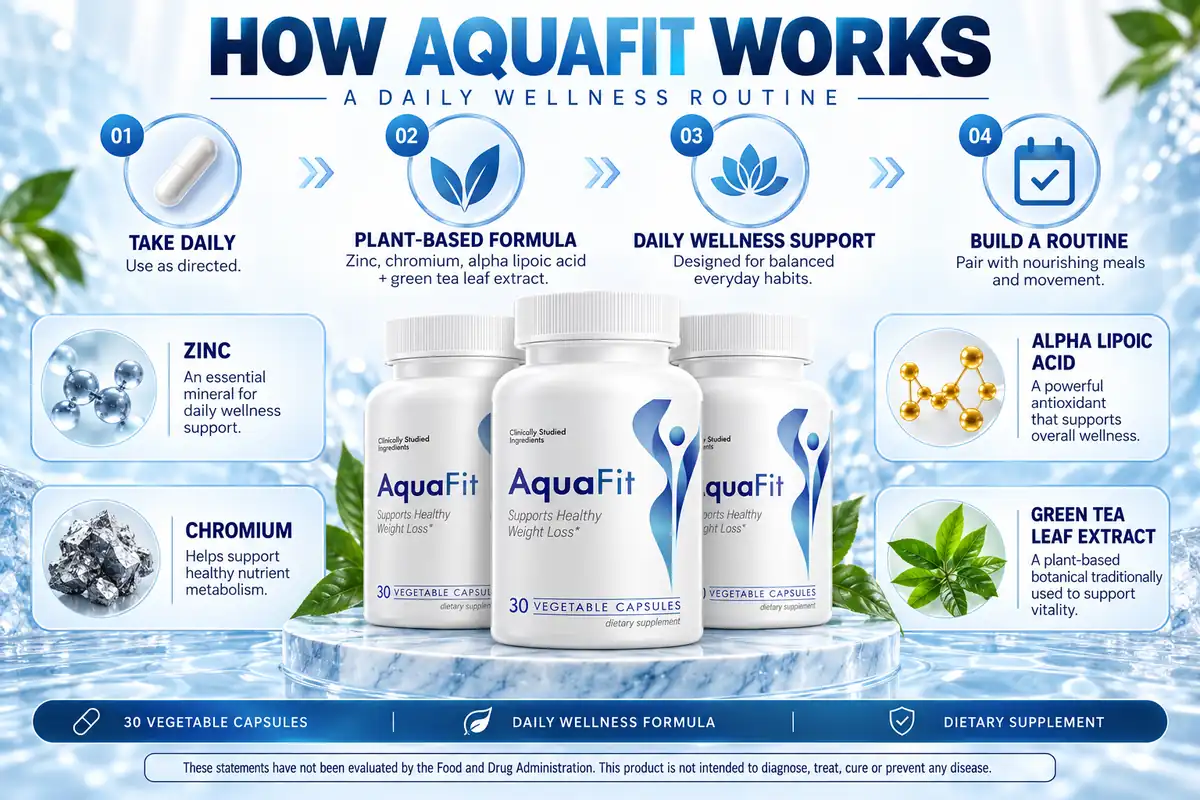
Notice what the diagram does not contain: any timescale at all. No days, no weeks, no “results in”. That absence is a compliance decision rather than an oversight, and it is the correct one. A quantified timeline on a supplement label is the kind of claim the FTC publishes consumer guidance about (the FTC).
So the three-to-six week figure comes from the review summary rather than from the packaging, and it should be read as a description of what buyers said rather than as a schedule the product is committed to.
How to tell whether anything is happening
Six weeks is long enough that memory stops being reliable, and impressions over that period drift towards whatever you expected at the start. A log fixes that, and it takes under a minute a day.
- Weight, twice a week, same time and same clothes. Daily readings are mostly water and will convince you of things that are not happening.
- A waist measurement, weekly. It moves when the scale does not, and the clinical guidelines treat it as its own measure (Jensen 2014).
- One tick a day for the capsule. The only variable you actually control.
- Evening energy, scored one to five. Two of the eight published reviewers mentioned this before mentioning anything else.
- The purchase date, written down once. Because the guarantee runs from it.
Self-monitoring is not administration. It is the single behaviour most consistently associated with results across the weight literature (Burke 2011), and the long-term maintenance data points the same way (Thomas 2014). Here it does a second job as well: it turns a vague sense of whether something is working into a decision you can actually make before day 60.
When to stop waiting, and what to do then
A timeline article that never says stop is a sales page with dates on it. Three situations where the answer is to stop.
- Day 45 with nothing in the log. Open a refund claim. You can always reorder if you change your mind; you cannot reopen a window that has closed.
- Anything that changes sharply, at any point. Stop and speak to a clinician, and take the bottle so they can read the lot. On a product with no published panel you have no way to look a symptom up, which lowers rather than raises the threshold for asking.
- The routine has not survived two weeks. If the capsule is being missed more often than it is taken, the trial is not running. That is worth knowing at day 14 rather than at day 55.
A note on this category. AquaFit is a dietary supplement, not a treatment for any condition. If you are managing a diagnosed condition or taking prescription medication, speak to a clinician before starting, and tell them plainly that this label names no ingredient. That fact changes what they are able to check on your behalf.
Sources
- Bessell E, Maunder A, Lauche R, et al. Efficacy of dietary supplements containing isolated organic compounds for weight loss: a systematic review and meta-analysis of randomised placebo-controlled trials. Int J Obes (Lond). 2021;45(8):1631-1643. https://pubmed.ncbi.nlm.nih.gov/33976376/
- Batsis JA, Apolzan JW, Bagley PJ, et al. A Systematic Review of Dietary Supplements and Alternative Therapies for Weight Loss. Obesity (Silver Spring). 2021;29(7):1102-1113. https://pubmed.ncbi.nlm.nih.gov/34159755/
- Greenway FL. Physiological adaptations to weight loss and factors favouring weight regain. Int J Obes (Lond). 2015;39(8):1188-96. https://pubmed.ncbi.nlm.nih.gov/25896063/
- Jensen MD, Ryan DH, Apovian CM, et al. 2013 AHA/ACC/TOS guideline for the management of overweight and obesity in adults. Circulation. 2014;129(25 Suppl 2):S102-38. https://pubmed.ncbi.nlm.nih.gov/24222017/
- Burke LE, Wang J, Sevick MA. Self-monitoring in weight loss: a systematic review of the literature. J Am Diet Assoc. 2011;111(1):92-102. https://pubmed.ncbi.nlm.nih.gov/21185970/
- Thomas JG, Bond DS, Phelan S, Hill JO, Wing RR. Weight-loss maintenance for 10 years in the National Weight Control Registry. Am J Prev Med. 2014;46(1):17-23. https://pubmed.ncbi.nlm.nih.gov/24355667/
- Federal Trade Commission. The Truth Behind Weight Loss Ads. https://consumer.ftc.gov/articles/truth-behind-weight-loss-ads

We write these pages from the AquaFit label, the distributor’s own paperwork and the order desk, cite public research for every compound we name, and print “not published” wherever a figure is not disclosed rather than estimating it. This label names no ingredients and publishes no panel, and we say so on every page where a buyer would look for one. Corrections are made on the page and the review date moves forward. Write to [email protected]. Every page, every journal post, the bottle facts and the ingredients go through review by Dr. Chioma Okafor-Mbah, MD before they ship. Last reviewed September 2026 by Dr. Chioma Okafor-Mbah, MD.